Pages

Our Lady's Little Scribe seeks to use the internet for sharing the Catholic faith and Franciscan spirituality, going from Gospel to life and life to the Gospel.


The silk painting, shown above, is by Ty Mam Duw, Poor Clare Colettines, Hawarden, WALES GB. Their website is here. Ty Mam Duw is Welsh and means The House of the Mother of God. Our Lady of the Pearl cherishes their friendship and is grateful for their many kindnesses and prayers. The image is used with permission.

Entertaining Angels

Entertaining Angels
You are welcome to join in with your thoughts and spiritual inspirations and to share information. To write, click the word "comments" found after each post.
Showing posts with label Penance. Show all posts

Friday, August 15, 2008

The Lent of Saint Michael

August 15 - September 29

Our Lady’s Little Portion and Our Lady of the Pearl, Secular Franciscan Fraternities, St. Joan of Arc Region, ask that you join with us in prayer and fasting for our country during the Lent of Saint Michael, from August 15th - September 29th. The United States, as a Christian Nation, desperately needs God`s hand of protection over it during our upcoming presidential elections.

In the writings of St. Francis, we are reminded again and again that Franciscans are called to be penitents, to pray and fast. Saint Michael’s Lent is a period of 40 days, honoring Mary and Saint Michael the Archangel. It begins on the Feast of the Assumption and ends on The Feast of the Archangels.

Monday, February 18, 2008

Let Us Show Each Other God's Generosity


by Saint Gregory of Nazianzen

The following is an excerpt from a sermon on the love of poverty by Saint Gregory of Nazianzen, Office of Readings for Monday of the First week in Lent. Gregory of Nazianzen was patriarch archbishop of Constantinople at the time of the First Council of Constantinople which revised revised the Nicene Creed in 381 AD.

Recognize to whom you owe the fact that you exist, that you breathe, that you understand, that you are wise, and, above all, that you know God and hope for the kingdom of heaven and the vision of glory, now darkly as in a mirror but then with greater fullness and purity. You have been made a son of God, co-heir with Christ. Where did you get all this, and from whom?

Let me turn to what is of less importance: the visible world around us. What benefactor has enabled you to look out upon the beauty of the sky, the sun in its course, the circle of the moon, the countless number of stars, with the harmony and order that are theirs, like the music of a harp? Who has blessed you with rain, with the art of husbandry, with different kinds of food, with the arts, with houses, with laws, with states, with a life of humanity and culture, with friendship and the easy familiarity of kinship?

Who has given you dominion over animals, those that are tame and those that provide you with food? Who has made you lord and master of everything on earth? In short, who has endowed you with all that makes man superior to all other living creatures?

Is it not God who asks you now in your turn to show yourself generous above all other creatures and for the sake of all other creatures? Because we have received from him so many wonderful gifts, will we not be ashamed to refuse him this one thing only, our generosity? Though he is God and Lord he is not afraid to be known as our Father. Shall we for our part repudiate those who are our kith and kin?

Brethren and friends, let us never allow ourselves to misuse what has been given us by God’s gift. If we do, we shall hear Saint Peter say: Be ashamed of yourselves for holding on to what belongs to someone else. Resolve to imitate God’s justice, and no one will be poor. Let us not labor to heap up and hoard riches while others remain in need. If we do, the prophet Amos will speak out against us with sharp and threatening words: Come now, you that say: When will the new moon be over, so that we may start selling? When will the sabbath be over, so that we may start opening our treasures?

Let us put into practice the supreme and primary law of God. He sends down rain on just and sinful alike, and causes the sun to rise on all without distinction. To all earth’s creatures he has given the broad earth, the springs, the rivers and the forests. He has given the air to the birds, and the waters to those who live in the water. He has given abundantly to all the basic needs of life, not as a private possession, not restricted by law, not divided by boundaries, but as common to all, amply and in rich measure. His gifts are not deficient in any way, because he wanted to give equality of blessing to equality of worth, and to show the abundance of his generosity.

Tuesday, October 23, 2007

Concerning Those Who Do Not Do Penance

This is a continuation of my post on October 21st, "Concerning Those Who Do Penance." The name of the book that I referred to in that post is My Visit to Hell by Paul Thigpen. I ordered it after reading an interview of Thigpen on Zenith, a Catholic site. The interview is here. "Thigpen is editor of The Catholic Answer, director of the Stella Maris Center for Faith and Culture, and an award-winning journalist and best-selling author of 34 books."

This novel is a modern-day adaptation of Dante's Inferno, the 14th century poem about a visit to hell. My Visit to Hell provides a frightening, thought-provoking guided tour of hell through the eyes of the main character, Thomas Travis. This book will encourage all to run to confession and to flee to God for healing and forgiveness. It is not difficult to read and understand and holds one's attention to the end.

As one reads, it becomes more and more apparent how true are the words of Paul in Romans that "all have sinned and fall short of the glory of God." What is the hope for us? The same as it was for Thomas Travis in My Visit to Hell.

What is the relationship between this book and Saint Francis? Read the second chapter of the Volterra text (http://www.ourladyofthepearl.com/rule.htm), written by Saint Francis. Here Saint Francis, writing in the 1200's, echoes Thigpen's book, and it is just as frightening. For example, one paragraph from the second chapter by Saint Francis is quoted below.

"The devil snatches the soul from his body with such anguish and tribulation that no one can know it except he who endures it, and all the talents and power and knowledge and wisdom which they thought they had will be taken away from them, and they leave their goods to relatives and friends who take and divide them and say afterwards, 'Cursed be his soul because he could have given us more, he could have acquired more than he did.' The worms eat up the body and so they have lost body and soul during this short earthly life and will go into the inferno where they will suffer torture without end."

All we like sheep have gone astray; we have turned every one to his own way; and the LORD hath laid on him the iniquity of us all." Isaiah 53.6.

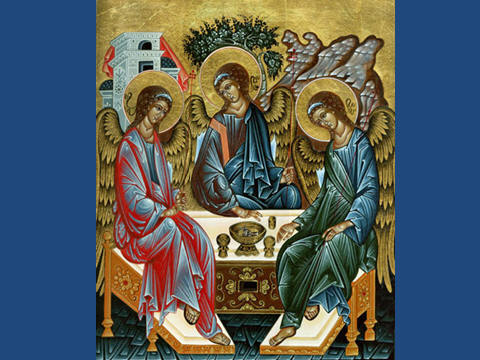
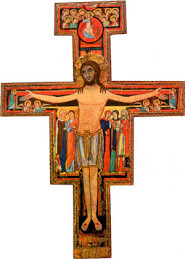
Our hope - our redemption - lies only in the cross - in Jesus Christ. Saint Francis knew this. He knew that God loved him - that he loves all of us. In joy and gratitude, Francis embraced the cross. Through prayer, the Spirit of God breathed within him, drawing him into the circle of love between the Father and the Son. He danced with the Trinity.

So can you.

Peace and All Good,
Little Scribe

Sunday, October 21, 2007

Concerning Those Who Do Penance

The Volterra text, written by Saint Francis, around 1209-1215, is an exhortation given to those first penitents who came to Frances wanting to share in his Gospel way of life. This exhortation to the Brothers and Sisters of Penance, as they were called, is the Prologue to The Rule of the Secular Franciscan Order. It has two chapters. The first chapter is addressed to those who do penance, and the second chapter, to those who do not do penance. The Volterra text may be read on the website for Our Lady of the Pearl at http://www.ourladyofthepearl.com/rule.htm.

My primary focus always has been the first chapter because it is more positive and uplifting and provides spiritual direction, written briefly, on how to live a life of penance. In this chapter, Francis puts the commandment of love as the foundation for the life of penance. To do penance is to love God and one's neighbor. Then, one must resist the sinful tendencies of our fallen nature, the cause of "vices and sins." This process is not possible through human effort alone. A sacramental life, the source of grace, especially the Eucharist, is necessary. One must "bring forth fruits worthy of penance"; that is, one must act in conformity with the conversion that has been accepted. The result of such conduct will be the attainment of that happiness which man desires and will effect the person's sharing in the trinitarian life of God. This is the essence of the life of penance.

  • Love God
  • Love one’s neighbor
  • Resist the sinful tendencies of our fallen nature
  • Participate in the sacramental life, especially the Eucharist
  • Act in conformity with the conversion that the person has accepted (worthy fruits of penance)

My next post will be on the second chapter of the Volterra text, concerning those who do not do penance. I will also give the name of a very good novel I have just finished reading on the main character's frightening visit to hell, very much related to the second chapter by Saint Francis. The book is written by an award winning journalist and best-selling Catholic author, a summa cum laude graduate of Yale and PhD from Emory.

Peace and All Good,
Little Scribe