Pages

Our Lady's Little Scribe seeks to use the internet for sharing the Catholic faith and Franciscan spirituality, going from Gospel to life and life to the Gospel.


The silk painting, shown above, is by Ty Mam Duw, Poor Clare Colettines, Hawarden, WALES GB. Their website is here. Ty Mam Duw is Welsh and means The House of the Mother of God. Our Lady of the Pearl cherishes their friendship and is grateful for their many kindnesses and prayers. The image is used with permission.

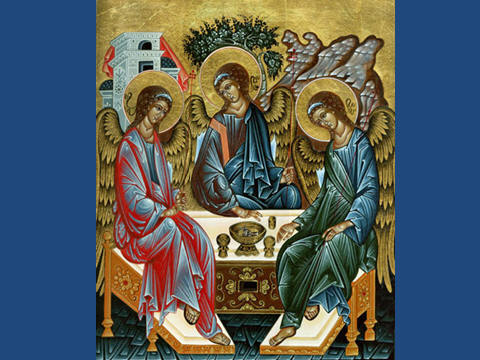
Entertaining Angels

Entertaining Angels
You are welcome to join in with your thoughts and spiritual inspirations and to share information. To write, click the word "comments" found after each post.
Showing posts with label Grief. Show all posts

Monday, September 26, 2011

To those who are grieving & have hearts full of sorrow

So many of my friends are grieving the loss of a loved one, and since Tom (my husband) passed away, I have looked for something I could read which might help explain some of my feelings. I highly recommend this book, Awakening from Grief, Finding Our Way Back to Joy, by John E. Welshons.

I could not help but include the first section on page 153 from this book. I include it for all the “non-believers.” We “believers” already know about pets. Some of us are grieving for human loved ones, but there are also some of us who are grieving for the loss of our dogs or perhaps are grieving for both the human and dog loved ones.

Purchase at amazon.com.

Excerpt from Awakening from Grief, Finding Our Way Back to Joy, by John E. Welshons. Pages 153 – 155.

CONSIDER GETTING A PET

If you don't already have a pet, consider bringing one into your life and your home. Dogs, cats, and other animals can be wonderful companions. They can help you to feel needed and loved. They can give you a sense of responsibility and a connection to another living being. The care, nurturing, and love they require can help you to focus on something outside your own sadness and confusion. And the love, companionship, and protection they provide in return can be extraordinarily rewarding. Tuning to the rhythms of another species, learning their needs and habits, and seeing their instincts manifest can add a wonderful depth and new dimension to your life. They cannot replace a loved one, but they can bring a very refreshing new quality to your daily experience.

RELAX AND TAKE YOUR TIME

Don't feel that there is any rush. Our society always wants us to "feel better fast.” If you want to work with grief in a way that will be truly enlightening, that will have a lasting effect, that will integrate into your experience in a meaningful way, it will take time.

In a very real sense, grief never ends. We merely learn how to incorporate it into the totality of our beings rather than push it away. When we can embrace all of the aspects of human life - the joys and the sorrows - we no longer fear that we will drown in sadness. But we must be willing to feel it. It's part of the curriculum we're taking. The unwillingness to feel is what drowns us.

So it may take weeks, months, or years. And fifty years from now we may still cry because the human side of us misses having a loved one physically present. But we are not our bodies, and our relationships don't exist in our bodies - they exist in our hearts, in our minds, in our souls. When we become aware of that reality, we begin to loosen the grip of grief.

The cruelest thing we can do to someone in grief is to suggest that they should be “getting over it" within some predetermined time span. A mother who has lost a child never gets over it. She will, hopefully, go on with life, love more deeply, feel grateful for the time she did have with that child, and become more consciously attuned to her other children, if she has others. But she will never “get over it.” The pain is the child's legacy to the parent. Hopefully; the parent can use the pain as a lever to pry open whatever doors in the heart have been closed.

Grief is a part of human life. We don't get over it. We can, however, use it as a tool to grow, to improve our relationships, to remind us to stay present in this moment, to experience the expansiveness and radiance of our beings - who and what we really are - and the truth that grief is only a portion of who we are. We can fully and consciously confront our grief and at the same time laugh, love, rejoice, and live our lives with energy, conviction, and enthusiasm. Grief is a problem in our society only because we are so afraid of it.

PRACTICE THE BREATH THAT HEALS

One of the most healing methods of working through grief is the practice of breathing into the heart space in the center of the chest. Take some time each and every day to do the following: Close your eyes and bring your awareness to the place in your chest where your heart resides. Breathe deeply in and out of that center, imagining that you have a large opening where your sternum (the solid bone in the center of the ribcage that protects the heart) is located. Take several deep, long, slow, relaxed breaths and imagine that you can feel the air gently moving through that opening like a warm reassuring breeze.

Then gently imagine a warm, light-filled, candlelit room in the center of your chest. All of your loved ones reside within that room. Imagine each of them in the form that is most dear to your heart, the one that makes you feel the most love. Take time to visualize each one, working primarily with the ones you miss the most. See and feel their presence there. Know that they are always with you. Know that you can always talk to them, ask their advice, laugh with them. This is not living in the past - it is the recognition that our love is always alive. It is most alive in this present moment.

Ask your loved ones for their guidance. Ask them to help you overcome your loneliness. And remember, your loved ones are always with you, eternally alive in the warm, soft womb of your heart. You are not alone.

* * *

Excerpt from Pages 196 - 200

Hurricanes, the most dangerous and destructive forces in nature, have at their cores a circle, perhaps twenty to thirty miles in diameter, of calm, sunlight, and serenity. This circle is known as the "eye" of the storm, a vast, tranquil, open space around which the cyclonic storm swirls.

In the “eye" there is no wind. No rain. No clouds. No destruction. The sun shines. There is peace. It's a fascinating phenomenon. In the center of the most violent, raging, destructive force in nature, there is quiet ... calmness ... serenity.

In the months and years following a loss, we feel as though we're caught in an emotional storm. We are consumed with a sense of swirling, unpredictable danger, a profoundly unbalanced agitation, an unrelenting anxiety. But we have forgotten that we also have a calm center. In this case, the “I” of the storm.

We have forgotten that at the core of our beings is a detached, dispassionate awareness that watches it all with equanimity. It is the part of us that never changes. It is the part of us that transcends death. It is the part of us we call the "soul.”

But, like many other things our modern, technological society has ignored, our spirits - our souls - have been neglected for centuries. We hardly even know we have them. We read about them in holy books, but we don t really know them. Our popular religious traditions have left us with few methods for consciously recognizing their presence within us. But there are little glimmers throughout our lives.

In chapter 17, we made reference to those moments in the middle of a terrible argument with a loved one when we hear a little voice inside saying, "Isn't this ridiculous?!" At those times we sometimes fight against our inclination to dissolve into laughter, though we may be suddenly impelled to hug, kiss, and forgive the offender. There's a part of us watching it all from another vantage point.

At times of extreme danger, we may also notice that there is a dispassionate awareness watching our fear, watching our minds freak out, giggling with recognition that our terror is almost laughable. Virtually all the people I've ever spoken to who have experienced a sudden, unforeseen "accident" or frightening turn of events have reported that they noticed a calm awareness from which they were watching it all without fear. It's as if at moments of sudden shock or great stress our minds burn out momentarily and allow our conscious¬ness to dissolve, however briefly, into the pure, undifferentiated, peaceful awareness of our souls.

Similarly people who have had "near death" experiences talk about witnessing their consciousness rising up out of their bodies and hov¬ering overhead as they watch and listen to events unfolding in the room below-the doctors and nurses scurrying to resuscitate them, the panic, the hopelessness, the resignation, sometimes even jokes that are told in the room. And then they return and report, to the doctors' and nurses' astonishment, that they were aware of everything that was said, and everything that happened while they were “dead.”

As these events unfold, we notice that if fear does arise, it often arises after the fact. At the height of danger, our consciousness stays clear and calm. We calmly watch our cars spinning out of control on ice. Only after they stop do we dissolve into terror as our minds "re¬play" the danger we just avoided. At a moment of danger, we may see our lives flash before our eyes in a millisecond. But while it is happening our minds are calm.

We touch this state of serenity during moments of profound joy or at moments of unaccustomed tranquility, like the moments we spoke about in chapter 12 when we are sitting by a river, or the ocean, or on a mountaintop. One friend of mine feels it when he is trout fishing, standing waist-deep in the center of the stream, aware only of the water moving against his legs, the breeze, the gentle swaying of the leaves in the trees, and the singing of the birds. Another feels it in his boat, out at sea, with no land in sight, no other boats in sight, just the swelling of the waves and the interplay of wind and sail. Another feels it when she is scuba diving, entering another world - a world of vast silence and radiant, pulsating, shimmering beauty.

Throughout our lives, that inner place has always been present, but it's been ignored. So when we touch it, it comes as a surprise. We don't recognize it. We think of it as an aberration.

That state of calm, dispassionate awareness is always available to us. And, with a little practice, at any moment, it is possible for us to tune to that inner place, to recognize it, to hear its wisdom.

It is the place meditation can take us. It is the place contempla¬tive prayer aligns us with. It is the place tai chi attunes us to. Each of these methods and many others seek to familiarize us with that which lies at the core of our beings, that which is eternal, unchanging, ever present; that which, in the end, is the only thing that can truly satisfy us, sustain us, nurture us, and fulfill us. It is the place we are really seeking when we "fall in love.” And it is the place we need to connect with to integrate all of life's inevitable losses into our beings.

Our society, in its zeal to" protect" us from suffering, has actually created a kind of emotional and spiritual paralysis. And that paralysis has inhibited our ability to see and perceive things as they are, because things as they are have seemed too frightening. Things, as they are, are only frightening when we have no awareness of a "higher" power, when we have no awareness of a transcendent reality that is timeless and cannot die, and no awareness of our connection to it.

Once we begin to gain that awareness, we can look directly at our lives without fear. We can look at the reality that everything in form is impermanent. Everything changes. Everything decays and dies.

The curse of being human is that our rational minds always seek to "understand,” to make rational sense of something that is, by its nature, completely beyond the mind's ability to grasp. But we keep trying. We keep attempting to understand how God or the Universe can, at times, seem so cold, so heartless, so cruel ... how life in form can seem so chaotic.

The blessing of loss is that it offers us situations in which the pain is so devastating, the sequence of events so confusing, we are "thrown" out of our minds. The hope is that we will come to understand that our minds cannot "think" us back to peace and contentment.

We can begin to "feel" our way through, to instinctively sense the other levels of awareness and existence within ourselves. And in that instinctive feeling, we can find the part of us that transcends death. When we find it, we recognize its oneness with the part of our loved ones that transcends death. It's the same thing.

What is found in our loved ones is found in ourselves. It's our connection to our hearts. It's our connection to each other. It's our connection to our Creator.

A sailor unexpectedly caught in a hurricane knows his only hope is to find the eye of the storm, sail to it, and remain inside it, moving within the storm, at its center, until it subsides. It may take days - ¬even weeks - of vigilant effort. But within the "eye,” while the raging storm swirls all around him, both he and his craft will be safe.

Like the "eye" of the hurricane, the “I” within each of us, within the often chaotic storm of human life, sits quietly and serenely at our core. And, confronted with the terrible devastation of loss, what choice have we but to sail into our “I”? To find our own soul? To connect with the highest and deepest spiritual awareness we possess?

We need only find ways to approach our "I,” to recognize it, and to learn how to connect with it. To "reside" in it at will. It is the transition from thinking to intuition. It is the journey from the mind to the heart. It is the unveiling of our soul. It is the rebirth that death and loss offer us.

May we all recognize the silver lining in each dark cloud ... the “I” of the storm.

(End of quotations from the book.)

* * *

In the Eye of the Storm

In the eye of the storm
where it’s safe and warm
I will fly to you
I'll find you
in the eye of the storm. . . .

My heart may be broken
My life may be stolen
but you can't take my Jesus from me.

In the eye of the storm
where it's safe and warm
I will fly to you
I'll find you
in the eye of the storm. . . .

You are my hiding place
You are my Savior
You are all that I need. . . .

(“Eye of the Storm,” Kitty Cleveland, from her album, “Be Not Afraid”)

Find more artists like Kitty Cleveland at Myspace Music

Saturday, February 2, 2008

In The Eighth Month

Ground zero – Hurricane Katrina! What was it like for a Secular Franciscan community at ground zero? Many continue to ask about the coast of Mississippi so I am posting this account of our story - our story in the midst of one of the most devastating natural disasters in United States history. In a nutshell, it will be years before the coast of Mississippi has recovered and much has been lost forever. As a whole, we continue to suffer and have many problems. Our story below is also found on our website at http://www.ourladyofthepearl.com/.


The Story of Our Franciscan Community
and Hurricane Katrina
Written September 2006
Updated August 29, 2007
by Ouida Tomlinson, SFO

We are Our Lady of the Pearl, Pearlington, Mississippi, a Secular Franciscan community with thirteen members. We are located on the Mississippi Gulf Coast, in Hancock County. We are an emerging fraternity, seeking canonical establishment. Most of us have been very good friends for many years, but our time as a Franciscan group began in the fall of 1996. Our meeting place was the Francis House, in Pearlington. It was in the direct path of the eye of the hurricane.

Hurricane Katrina hit the Mississippi Coast as a category 3 hurricane, with sustained winds of 125 mph. Hurricane-force winds extended up to 190 miles from the center of the storm and tropical storm-force winds extended for approximately 440 miles. The Mississippi Coast was in the northeast quadrant, the most dangerous side of a hurricane. The center of the eye crossed the Mississippi-Louisiana border, near the mouth of the Pearl River, traveling north over Pearlington and Poplarville, Mississippi . The eye came directly over all of our homes, in the eighth month of 2005, on August 29th.

Massive destruction occurred across the entire Mississippi Coast. The storm surge was up to 35 feet. It penetrated at least six miles inland and up to 12 miles along bays and rivers. Numerous tornadoes compounded the hurricane’s deadly winds and water surge. People lost their lives. Millions of trees were destroyed along with wildlife, pets and domesticated animals.

Of the 171,000 homes in the coastal counties, 38% were destroyed, 22% suffered major damage, and 30% had damage. An estimated 350 buildings listed in the National Register were damaged or destroyed. Ten Catholic Churches were destroyed or gutted, ten had major damage, and four were declared unusable.

From the coast to some areas two hundred miles or more to the north, there was no electricity, water, telephone service, cell phone service, gasoline, groceries, medical or other critical services. Entire coastal communities were obliterated. All socio-economic classes and races were hit. There was no discrimination. The rich along with the poor continue to say, “We lost everything.”


OUR LADY OF THE PEARL

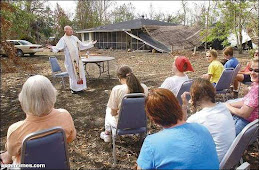
In Pearlington, Fr. James O’Brien said that the town suffered destruction of atomic proportions. It became a wasteland of frightened, homeless people and broken hearts. St. Joseph Catholic Church was leveled with only the steps remaining. The meeting place of Our Lady of the Pearl, the Francis House, was left with only the slab, and all contents gone. Everything was swept clean and disappeared.

In the midst of this tragedy, Our Lady of the Pearl members held together as a family. Within a day or so after the hurricane, we began looking for each other. Initially, the primary difficulty was that none of us were at our usual places. All of us evacuated, either before or after Katrina. Also, telephones, cell phones and the internet were not working well or at all. This loss of communication was one of the scariest parts.

Gradually, over those early days, we were able to verify that all members were alive, and we spread news about each other through the crippled lines of communication. Slowly other news – sad news - also was confirmed about our members, our families and the way of life we had lost.
Some members of Our Lady of the Pearl lost their homes and all possessions; most of the remaining ones suffered extensive damage to home and property and losses of all or most of their possessions. Anything that was left, was covered with mold. Many of our adult children suffered the same type of losses.

Nature also suffered. We lost beautiful trees, shrubs, flowers and grass. The land was stripped bare, and the ground was covered with a tarry, black yuck, left by the flooding. At times we seemed to hear the trees crying and all nature sobbing, joining us in our tears and sorrows.

We often said we didn’t know where we belonged anymore except with each other and that everything had changed. We stayed in contact, especially as telephones, cell phones and internet services returned. During the early weeks and months after Katrina, two, three or more came together regularly and sometimes weekly. We had the Transitus of St. Francis in October, and some met in Natchez for retreats.

A year after Katrina most of those of Our Lady of the Pearl with standing homes still had much repair work to be done. Some homes continued to be unlivable. Much delay has been caused by insurance settlement problems, being under insured or not being able to find contractors and laborers to do the work.

There have been tremendous financial losses among us, and only a couple of us have been made whole by insurance proceeds or other sources. The standard of living has declined greatly for some. A few members who had retirement funds or savings have dug deeply into these resources to have livable homes. Others had no savings. Some have lost their businesses or jobs.

All of us have suffered and continue to suffer from episodes or periods of what has become referred to as post-Katrina stress syndrome. This includes an inability to concentrate, low energy, exhaustion, depression, grief, confusion, inability to remember, anxiety, anger, and sadness. The list goes on. The stress also has brought on physical problems such as chest pains, heart problems, weight loss or gain, headaches and other symptoms.


OUR MEMBERS ENCOUNTER KATRINA

Hedy, her husband, and family stayed in Pearlington during the hurricane, on the top floor of their raised home. It overlooked the Pearl River , and the water rose approximately 30 feet or more, filling the lower part of the house. It was gutted and destroyed by the wind and flood waters, which took away all of the contents.

Ann and her husband also lived in Pearlington. The interior of their home had water to the ceiling, causing extensive damage. They too lost furniture, furnishings, clothing and other personal property. They lost over 600 trees. One year after Katrina, repair on their home was almost finished.

Eileen and Renee were neighbors in Bay St. Louis, Mississippi, about 17 miles further east of Pearlington. They lived across the street from the Bay of St. Louis . Both families lost their homes and all contents, with nothing left except the frame or slab.

Bobbye also lived in Bay St. Louis, within a couple of blocks of the Gulf. Her home is on a ridge, at an elevation higher than most. She and her husband stayed for Katrina. Their home was flooded with about three feet of water. Contents on the first floor had to be thrown away. The flooding and the mold required extensive cleaning and renovations, which were incomplete one year after Katrina.

Tom and Ouida live in Diamondhead , Mississippi , situated north of the Bay of St. Louis and about 22 miles east of Pearlington. They had only minor roof damage and several trees down, but less than one mile from them, homes were gutted by tornadoes or the storm surge. Less than two miles away, homes and businesses were obliterated, with nothing left.

Bob and Patty stayed for Katrina at their home in Poplarville, north of the coast and approximately 60 miles from Pearlington. They had extensive damage to their three-story home. It was hit by a tornado which sucked out a sky light. Water flooded the house, causing much damage and losses to the structure and contents. They evacuated and returned a month later to find everything covered with mold. It took almost one year to restore their home.

John and Carol lived in Slidell, Louisiana, near Lake Ponchatrain and approximately 15 miles west of Pearlington. Their home in Slidell received about four feet of water with extensive damages and losses and is not livable without massive repairs. They are living in a FEMA trailer in Poplarville , Mississippi .

Karen lives in Pearl River, Louisiana, near Slidell and about 20 miles from Pearlington. Over half the roof of her home in Pearl River had structure damage from the eight trees falling on it, but the house was livable. There were 46 trees down on their one acre plus lot.
Debbie lives further west, in Mandeville, Louisiana, north of Lake Ponchatrain and New Orleans and about 40 miles from Pearlington. Her home also had damage.


OUR FIRST COMMUNITY GATHERING AFTER KATRINA

On November 5, 2005, Ann, who had relocated to Slidell, Louisiana, was able to offer the hospitality of her home for our first post-Katrina community meeting, and we have met every month since. This November gathering was one that we shall never forget. We were still in shock as to all that had happened.

We read St. Francis’ description of true joy that he gave to Brother Leo. In all that we were experiencing in our lives, what we needed most was patience and joy. St. Francis’ words went straight to our hearts. We said that to experience the very worst that can happen to us with patience is to experience true joy.

Our discussions that day covered many subjects such as how were we to respond as Christians and Franciscans and what did God expect of us in the midst of Katrina’s devastation. We reminded ourselves that God requires two things of us: to love our Lord our God with all our heart and second, to love our neighbors as ourselves.

We asked why we had to suffer. We asked if this was a purification, such as was experienced by God’s people in the Old Testament when they fell away from him, then why did we, God’s faithful children, have to suffer and lose so much? Part of the answer seems to be that we must live along side others who are Katrina victims to be God’s presence. We are serving him in our suffering. We had to be here, in this place, at this time, when Katrina came
.
We came away that day with the knowledge that we had been stripped of all things, but as Christ’s followers, in the footsteps of St. Francis, we knew that God loves us and would never hurt us and that he wants us to find our peace, love and joy in Him. We realized that these are the truths that we must take to all people in our lives and that by our example, we must bring the peace of our Lord, as spoken of by St. Francis.

During the year following Hurricane Katrina, Our Lady of the Pearl learned much from our experiences. We have a deeper insight into human suffering and a greater sympathy with its victims. We have learned that things and stuff are not so important. There is a greater desire to simplify our lives. Our priorities have changed. The importance of God, family and loved ones is very clear, and there is an enhanced appreciation for spouses. We have learned, over and over, that God loves us.


We are so grateful to be Franciscans as it has prepared us spiritually for these times. Also, we are so grateful for our community. It has provided a safe and supportive place in our post-Katrina world, a place to emotionally share our stories, grief and trauma at the deepest levels. A year after Katrina, one member aptly described our feelings: “I thank all of you for being there for me during this past year. You all are so important in my life - my stability during our most unstable time. I love you all.”


TWO YEARS LATER

It is August 29, 2007, two years since Hurricane Katrina. Many on the Mississippi Gulf Coast continue to struggle with making repairs to homes and businesses and struggle with insurance companies who have denied their claims. Recovery is blocked in many ways because business owners and home owners cannot afford or obtain insurance. Would-be home owners do not purchase homes for the same reasons.

We hear complaints from others that we should not live in hurricane areas and flood zones. They fail to understand that the storm surge (up to 35 feet in some areas) which followed and accompanied Katrina went into areas not classified as flood zones. Many did not have flood insurance because they do not live in flood zones. At the same time, weather related disasters are occurring all over the country so all in the United States are vulnerable to the weather no matter where we live.

Members of Our Lady of the Pearl Secular Franciscan community are at different stages of recovery from Katrina. Eileen, Hedy, and Renee lost their homes. Hedy moved to Natchez but hopes to rebuild in Pearlington. Eileen and Renee have purchased new homes. Most of the repairs have been completed at Bobbye’s, and John and Carol are working on their home repairs but still in a FEMA trailer.

The homes for the rest of us have been repaired. Ann is home again in Pearlington. Our community now meets in her guest house since the Francis House was lost in Katrina. St. Joseph Catholic Church was destroyed in Pearlington and will not be rebuilt. Only the steps are remaining, one of the many reminders of what has been lost forever along with the destruction to nature.

We miss our trees - young trees - centuries-old trees. We miss our grocery stores (only two in our county now), our doctors who have left, our friends who have moved away, our beautiful coastline, our way of life, our churches which were destroyed, our public services, public buildings, the antebellum homes, our stability (economic, emotional, and otherwise), schools, and on and on. The poor especially suffer in such areas as housing. Costs have soared, and there is little affordable housing for the poor and lower middle class. We miss the greater security we had from a lower crime rate. We miss - we miss. But the God of All Comfort is here, and in his presence, the things of earth grow strangely dim.


  • "God has created me to do Him some definite service; He has committed some work to me which He has not committed to another. I have my mission—I never may know it in this life, but I shall be told it in the next. Somehow I am necessary for His purposes, as necessary in my place as an Archangel in his—if, indeed, I fail, He can raise another, as He could make the stones children of Abraham. Yet I have a part in this great work; I am a link in a chain, a bond of connection between persons. He has not created me for naught. I shall do good, I shall do His work; I shall be an angel of peace, a preacher of truth in my own place, while not intending it, if I do but keep His commandments and serve Him in my calling."
  • Therefore I will trust Him. Whatever, wherever I am, I can never be thrown away. If I am in sickness, my sickness may serve Him; in perplexity, my perplexity may serve Him; if I am in sorrow, my sorrow may serve Him. My sickness, or perplexity, or sorrow may be necessary causes of some great end, which is quite beyond us. He does nothing in vain; He may prolong my life, He may shorten it; He knows what He is about. He may take away my friends, He may throw me among strangers, He may make me feel desolate, make my spirits sink, hide the future from me—still He knows what He is about. " Source: John Henry Newman

Monday, December 31, 2007

Our Joy is Now Our Sorrow


Sammy; David & Sammy; Teddy at bottom.

Gift of Thistle (click for music)

I hope to publish another blog soon for our family pets but today Our Lady's Little Scribe is the place we will remember and grieve for two precious ones, Sammy and Teddy, lost this month. Sammy was hit by a speeding car yesterday, December 30th, in front of his home. For some reason, he left his yard (during his potty break), crossed the street and wandered off for a few minutes. He was on his way home again when he was hit and gone in an instant. He was a bedlington terrier, very, very smart, funny and full of life. I groomed Sammy once. He was so good, very still and seemed to enjoy the whole process. He had a regal air about himself. I felt as if I were the attendant to a prince tho he occasionally bared his teeth in an ungentlemanly fashion. This happened if anyone became too bossy with him, not to threaten us but only because his nose itched when he became aggravated. He leaves behind his human family of mom, dad, and three brothers along with his special companion Lucy the dog and other furry ones. Sammy was my granddog. We are heartbroken.

Teddy came to live with us in the spring along with his lifetime companion Rosie, who is almost blind. They were rescued from the local shelter. Teddy was a Maltese mix, a very sweet and loving companion who followed my every step. I think he was happy living with us, maybe the happiest he had been in a long time. He seemed to be as he ran around the yard, barked at squirrels, and chased a cat or two, but he had a severe collapsed trachea, the worst our vet had ever seen. Breathing was very difficult. The medicine became less effective, and x-rays showed that the collapse was progressing with the possibility of a smothering death coming soon. On December 18th, my husband and I and Rosie accompanied Teddy to rainbow bridge where he waits for us. I held him in my arms as he crossed over. Our joy is now our sorrow.

How can we explain our tears to those who do not understand and have never experienced the deep devotion and bond between a dog and his humans? I know an elderly couple whose little dog was killed by a car (driven by a negligent friend). The husband told me that all they could do was cry. Day after day, they cried.

To bond with a dog is to know joy, laughter, affection unlimited, touch, love, the end of loneliness and always forgiveness. Always forgiveness. To share life on this level with one of God's creatures is, for some, the beginning of understanding of God himself.

Hail, holy Queen, Mother of Mercy!
Our life, our sweetness, and our hope!
To thee do we cry, poor banished children of Eve,
to thee do we send up our sighs,
mourning and weeping in this valley, of tears.
Turn, then, most gracious advocate,
thine eyes of mercy toward us;
and after this our exile show unto us the
blessed fruit of thy womb Jesus;
O clement, O loving, O sweet virgin Mary.
Pray for us, O holy Mother of God
That we may be made worthy of the promises of Christ.