Pages

Our Lady's Little Scribe seeks to use the internet for sharing the Catholic faith and Franciscan spirituality, going from Gospel to life and life to the Gospel.


The silk painting, shown above, is by Ty Mam Duw, Poor Clare Colettines, Hawarden, WALES GB. Their website is here. Ty Mam Duw is Welsh and means The House of the Mother of God. Our Lady of the Pearl cherishes their friendship and is grateful for their many kindnesses and prayers. The image is used with permission.

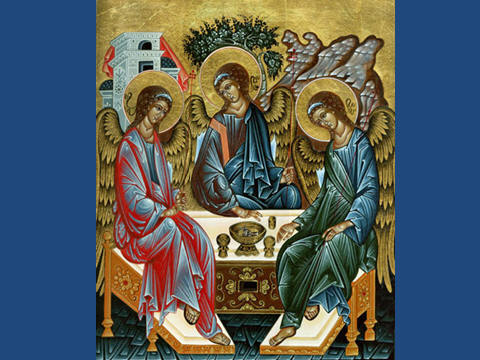
Entertaining Angels

Entertaining Angels
You are welcome to join in with your thoughts and spiritual inspirations and to share information. To write, click the word "comments" found after each post.
Showing posts with label Suffering. Show all posts

Monday, August 18, 2014

Let Us Walk Among Them With Works of Mercy

On this August morning, let us who call ourselves Christian, with a gentle and courteous spirit, "accept all people as a gift of the Lord and an image of Christ." Church, if you are seeking to help the poor, let us individually and as churches begin in our own towns and neighborhoods. The poor - the needy - the suffering are among us and they need us every day. They need for us "to love our neighbor as ourselves." They need for us to walk among them, distributing loaves and fishes.

Let us show charity to our neighbors with corporal works of mercy:

Feed the hungry

Give drink to the thirsty

Clothe the naked

Shelter the homeless

Visit the sick

Visit the imprisoned

Bury the dead

Let us show charity to our neighbors with spiritual works of mercy:

Admonish the sinner

Instruct the ignorant

Counsel the doubtful

Comfort the sorrowful

Bear wrongs patiently

Forgive all injuries

Pray for the living and the dead

From the Catechism of the Catholic Church on works of mercy:

2447 The works of mercy are charitable actions by which we come to the aid of our neighbor in his spiritual and bodily necessities. Instructing, advising, consoling, comforting are spiritual works of mercy, as are forgiving and bearing wrongs patiently. The corporal works of mercy consist especially in feeding the hungry, sheltering the homeless, clothing the naked, visiting the sick and imprisoned, and burying the dead. Among all these, giving alms to the poor is one of the chief witnesses to fraternal charity: it is also a work of justice pleasing to God:

"He who has two coats, let him share with him who has none and he who has food must do likewise." [Luke 3:11] "But give for alms those things which are within; and behold, everything is clean for you." [Luke 11:41] "If a brother or sister is ill-clad and in lack of daily food, and one of you says to them, 'Go in peace, be warmed and filled,' without giving them the things needed for the body, what does it profit?" [James 2:15-16]

Monday, February 13, 2012

Compassion is Suffering With

Monday, December 15, 2008

Abide With Me


A high school friend died yesterday. Jeanette was highly intelligent, very well educated and had many, many accomplishments. (See obituary here.) The summer of 1996, she announced to a group of us that she had what they thought was Alzheimer's. The last time I saw her was at our class reunion in 1998. Even then I could see the change in her.

As time passed the disease began to take hold. She lost her ability to communicate and was no longer in touch. She became bedridden and was in a fetal position. She had around the clock care. Eventually a feeding tube was inserted, and she went into a nursing home.

Her husband deserves great praise and honor as he provided her with the very best of care along with his love and devotion during this long goodbye. What a long journey this has been for him. May God bless him with many graces. I pray for both him and Jeanette.

Last night, while writing the material for our class blog and looking for music for the post, I stumbled upon a video of "Abide With Me." I truly felt God's hand in this provision and can imagine Jeanette singing as her world became darker and asking the Lord to abide with her. Now she is with God, living in his light. Completely whole.

ABIDE WITH ME

Abide with me fast falls the eventide,
The darkness deepens Lord, with me abide;
When other helpers fail and comforts flee
Help of the helpless, O abide with me!

Night surely comes to end this passing day,
Earth’s joys grow dim, its glories pass away;
Change and decay in all around I see
O Lord who does not change, abide with me!

I need your presence every passing hour,
What else but grace can foil temptation’s power?
Who else like you will guide and stay with me?
Thru cloud and sunshine, O abide with me!

I have no fear with you close by each day,
Trouble and sorrow swiftly pass away;
And at my end death will not conquer me
For I shall live if you abide with me.

Your holy cross, your resurrection,
Come shining through the gloom with hope salvation;
As morning breaks and as faint shadows flee
In life, in death, O Lord, abide with me!

Words: Henry F. Lyte, 1793-1847
Music: William Henry Monk, 1823-1889

Sunday, March 16, 2008

Have You Grown Weary?

I received an e-mail from a friend today, written to several Franciscans. She shared some of her struggles which are so similar to mine lately that I could have written it myself. She writes: “As we near the end of Lent, I pray that you have all had a fruitful journey. For me it has been a rough, dry walk. I have grown weary. Friends have told me that it is because I stretch myself too thin. I’m sure that’s true because I’ve always been a ‘Martha’ and find it hard to just ‘sit and know.’”

Does this sound familiar to you? It does to me. Yesterday (Saturday), after work, I started driving to Mass and was so overwhelmed with fatigue and pain that I turned around, went home and went to bed. These problems are ongoing.

For God's people, there is comfort in reading the lives of the saints who struggled with illness, various trials and had periods of dryness. For example, in reading about St. Francis, we are reminded about the period during his youth, when he went to fight with Assisi against Perugia and how Assisi lost the Battle of Collestrada in 1202. Francis was wounded and taken prisoner. He was 20 years old and spent a year in prison in Perugia. He was not well when he returned home. He spent weeks in bed and was ill for a long time.

Thomas of Celano, in The Life of Saint Francis, wrote:

  • "When he had recovered a little and, with the support of a cane, had begun to walk about here and there through the house in order to regain his health, he went outside one day and began to gaze upon the surrounding countryside with greater interest. But the beauty of the fields, the delight of the vineyards, and whatever else was beautiful to see could offer him no delight at all. He wondered at the sudden change in himself, and considered those who loved these things quite foolish."

How unlike the St. Francis we know - the lover of all creation! And then, there were other illnesses and sorrows to come. Probably he was sick all of his life from his 20's on, and as the numbers of Little Brothers grew, so did his sorrows as they drifted from his dreams for the Order.

At the end of his life, he wrote his great Canticle of the Sun and added his final verses as he embraced Sister Death and gave praise to God: "Praise and bless my Lord, and give Him thanks and serve Him with great humility."

Just as the Lord had plans for St. Francis, he has plans for us as well. Do not despair for the Lord is with us, and the Blessed Mother prays for us.

O give thanks to the Lord, for he is good,
for his steadfast love endures for ever.
Psalms 118:1

BOOK RECOMMENDATION

Aquinas and More Catholic Goods - For all your Catholic needs
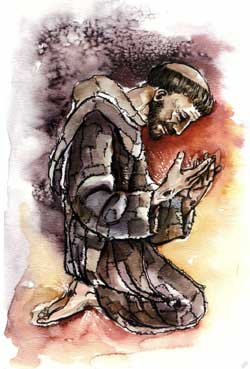
Francis
Francis

Sunday, January 13, 2008

Suffering

Excerpts from "Spe Salvi"
Pope Benedict XVI's Encyclical on Hope

"We can try to limit suffering, to fight against it, but we cannot eliminate it. It is when we attempt to avoid suffering by withdrawing from anything that might involve hurt, when we try to spare ourselves the effort and pain of pursuing truth, love and goodness, that we drift into a life of emptiness, in which there may be almost no pain, but the dark sensation of meaninglessness and abandonment is all the greater. It is not by sidestepping or fleeing from suffering that we are healed, but rather by our capacity for accepting it."

* * *

"A society unable to accept its suffering members and incapable of helping to share their suffering and to bear it inwardly through compassion is a cruel and inhuman society."

Read complete Encyclical.

Go to Boston Catholic Journal for audio.