On this August morning, let us who call ourselves Christian, with a gentle and courteous spirit, "accept all people as a gift of the Lord and an image of Christ." Church, if you are seeking to help the poor, let us individually and as churches begin in our own towns and neighborhoods. The poor - the needy - the suffering are among us and they need us every day. They need for us "to love our neighbor as ourselves." They need for us to walk among them, distributing loaves and fishes.
Let us show charity to our neighbors with corporal works of mercy:
Feed the hungry
Give drink to the thirsty
Clothe the naked
Shelter the homeless
Visit the sick
Visit the imprisoned
Bury the dead
Let us show charity to our neighbors with spiritual works of mercy:
Admonish the sinner
Instruct the ignorant
Counsel the doubtful
Comfort the sorrowful
Bear wrongs patiently
Forgive all injuries
Pray for the living and the dead
From the Catechism of the Catholic Church on works of mercy:
2447 The works of mercy are charitable actions by which we come to the aid of our neighbor in his spiritual and bodily necessities. Instructing, advising, consoling, comforting are spiritual works of mercy, as are forgiving and bearing wrongs patiently. The corporal works of mercy consist especially in feeding the hungry, sheltering the homeless, clothing the naked, visiting the sick and imprisoned, and burying the dead. Among all these, giving alms to the poor is one of the chief witnesses to fraternal charity: it is also a work of justice pleasing to God:
"He who has two coats, let him share with him who has none and he who has food must do likewise." [Luke 3:11] "But give for alms those things which are within; and behold, everything is clean for you." [Luke 11:41] "If a brother or sister is ill-clad and in lack of daily food, and one of you says to them, 'Go in peace, be warmed and filled,' without giving them the things needed for the body, what does it profit?" [James 2:15-16]
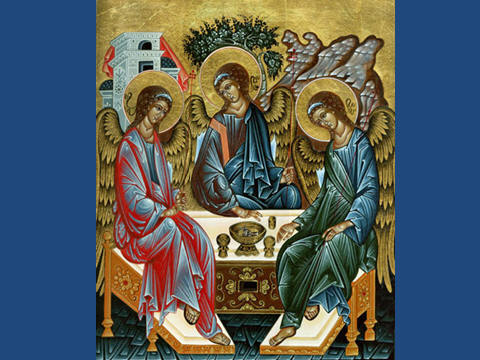
The silk painting, shown above, is by Ty Mam Duw, Poor Clare Colettines, Hawarden, WALES GB. Their website is here. Ty Mam Duw is Welsh and means The House of the Mother of God. Our Lady of the Pearl cherishes their friendship and is grateful for their many kindnesses and prayers. The image is used with permission.
Entertaining Angels
You are welcome to join in with your thoughts and spiritual inspirations and to share information. To write, click the word "comments" found after each post.
Monday, August 18, 2014
Let Us Walk Among Them With Works of Mercy
Friday, August 3, 2012
The Hole In Our Gospel
I am reading: The Hole in Our Gospel by Richard Stearns, President of World Vision U.S. Passages like Isaiah 58, Matthew 25, John 3:16-20, Job 29:11-17, Isaiah 61, 2 Corinthians 9:6-15, the Beatitudes, and so many others are jumping off the page, causing me to realize that there is a hole in our Gospel and I am strongly convicted.
Jesus had an expectation that we – his followers – not the government - should feed the hungry, give water to the thirsty, care for the sick, clothe the naked and give shelter to the homeless. That’s what he said. I assume he meant it.
“ . . . I could see that all across the world people were crying out in desperation to God for help, for comfort; widows, orphans, the sick, the disabled, the poor and the exploited. These millions of prayers were being lifted up to God, and we, each of us who claim to be His followers, were to be His answer. We were the ones who would bring the “good news” of Christ to the poor in their suffering. God has sent us. This was the good news of the gospel – good news indeed for the poor.” Stearns.
I WAS HUNGRY: 25,000 people die each day of hunger or its related causes – about 9 million people per year.
I WAS THIRSTY: As many as five million people die every year of water-related illnesses.
I WAS SICK: Three diseases alone – malaria, TB and AIDS – result in more than five million deaths per year and half a billion new infections, virtually all in the world’s poorest countries. AIDS has left 15 million children orphans.
Almost ten million children will be dead in a year, before they reach the age of five, caused by birth complication, pneumonia, diarrheal diseases, neonatal (infant) illnesses, malaria, measles, AIDS, injuries, and other.
(Statistics from Hole in Our Gospel)
My concern is more for the poor in other countries where they are starving to death every day, where there is no clean water and they walk hours every day to haul water that is contaminated and is killing them, where little children have no clothes at all and others have only what they are wearing, where they live in unsanitary conditions on dirt floors or maybe with no shelter at all, where a tooth infection or wounds mean death and there is little to no medicine or medical help available, no food stamps, and no government support such as in the U.S. These people in poor countries are beyond desperate – they are a living tragedy, making some of our poor look rich. That being said, through World Vision, one may make contributions to help kids in U.S.
Tuesday, April 8, 2008
Blessed Are The Poor In Spirit
Matthew 5:3
"By creating the Third Order, though, Francis did accept the distinction between radical commitment and the necessity of living in the world. The point of the Third Order is to accept with humility the task of one's secular profession and its requirements, wherever one happens to be, while directing one's whole life to that deep interior communion with Christ that Francis showed us. "To own goods as if you owned nothing" (cf. 1Cor 7:29ff.) - to master this inner tension., which is perhaps the more difficult challenge, and, sustained by those pledged to follow Christ radically, truly to live it out ever anew - that is what the third orders are for. And they open up for us what this Beatitude can mean for all. It is above all by looking at Francis of Assisi that we see clearly what the words "Kingdom of God" mean. Francis stood totally within the Church, and at the same time it is in figures such as he that the Church grows toward the goal that lies in the future, and yet is already present: The Kingdom of God is drawing near. . . . "
Tuesday, February 5, 2008
GREAT New Franciscan Blog!!
This morning I discovered the new blog of Br. William Short, OFM, Professor of Christian Spirituality at the Franciscan School of Theology and the Graduate Theological Union in Berkeley. I am writing to pass this great news along to all of you. Click here to go to his blog. It also may be found in the list of websites on this blog.
Most of us know Br. Bill as the co-editor of the three-volume series of English translations of all the documents written by St. Francis of Assisi and his earliest biographers: Francis of Assisi: Early Documents. He has also written other books on the history of the Franciscan movement (The Franciscans) and on its spirituality (Poverty and Joy: The Franciscan Tradition). For more information about him, click here.
To give you a taste of the great Franciscan teachings available on his blog, I have copied below his post of January 26, 2008.
by William Short, OFM
"Francis marks the beginning of his new life with the sign of meeting the leper. Those suffering from leprosy in the thirteenth century lived a radical poverty. They were “dead,” with funeral services celebrated over their still living bodies. Their property was confiscated; their family ties, friendship and social relations were broken. They lived by the gifts of others.
"The Lord led me among them”—Francis attributes this leading to the Lord. “What was bitter to me became sweet.” Francis finds among the lepers a quality, “sweetness,” which he usually attributes to God’s presence.
"And he wishes to stay among them, to be with “persons looked down upon, among the poor, the weak, the sick and the lepers, and those begging on the side of the road.” Among these, the persons looked down upon, Francis wishes to live. They are like Jesus “who was poor, and a guest, and lived by begging, himself and holy Mary the blessed virgin, his mother.”
"In the poor, Francis sees the image of Christ, the Image of God. The Lord Jesus Christ is poor in his birth, poor in his life, and poor in his death. And he wants to be in the world as one “looked down upon, needy and poor.”
"Francis embraces the leper, and with that gesture embraces the “holy Lady Poverty,” and her sister, “holy humility.” He does this out of a profound intuition that, through giving away everything, he will share in a truly divine activity; he will be accepting his true identity as made in the image of the poor God. “God created and formed you to the image of his beloved Son according to the body,” Francis said, “all spiritual and bodily things and ourselves were made to your image and likeness.”
"With his discovery of God’s poverty, Francis knows his own identity as made in God’s image, and recognizes his connection with all creatures—like him, they are images."
Tuesday, January 8, 2008
The Sacred Exchange between St. Francis and Lady Poverty
Sacrum Commercium Sancti Francisci cum Domina Paupertate is the Latin name for this allegory. It describes Franciscan poverty as a commitment to be followed by those who want to live the Gospel life. The author and date of this writing are unknown, but the date seems to be after the death of Saint Francis, perhaps in the middle of the thirteenth century.
In the prologue, the kingdom of heaven is presented as belonging to those who possess nothing. Francis is led to search for Lady Poverty because to her “the Lord had entrusted the keys of the kingdom of heaven.”
Sacrum Commercium is based upon a dialogue between Francis and Lady Poverty. She lives all by herself on a mountain. Francis easily climbs this mountain, because he is not encumbered by possessions. On the mountain, he praises Lady Poverty, “since the Son of God, the Lord of virtue and the King of glory, fell in love with this virtue with a special affection. He sought, found, and embraced it while achieving our salvation in the middle of the earth.” Lady Poverty is described as a most faithful spouse, a sweet lover, and the queen of virtues. She responds to Francis by giving an account of the whole history of salvation from Adam until Christ.
"I was once in the paradise of God, where man was naked. In fact, I was in man and was walking with naked man through that entire splendid paradise, fearing nothing, doubting nothing, and suspecting nothing amiss. I thought I would be with him forever, because the Most High created him just, good and wise and placed in the most delightful place. I was so happy playing before him all the while because, possessing nothing, he belonged entirely to God."
Lady Poverty continues to analyze the history of the Church. From apostolic times in Jerusalem, poverty passes over to the peace of Constantine. This marks the beginning of the Church’s relaxation in commitment to poverty. Later there is the birth of monasticism when poverty is rediscovered in the Church, but the monastic orders did not remain faithful to Poverty. The Christian proposal of Francis is an answer to Poverty’s wishes.
The Sacrum Commercium concludes by describing a meal prepared by Francis and the brothers for Lady Poverty. She rejoices at the extremely poor way of life which Francis and the brothers lead. After having a frugal meal and resting on a stone for a pillow, Lady Poverty asks the friars to show her their enclosure. Francis and the brothers lead her upon a hill and show her all the world, telling her: “This, Lady, is our enclosure.”
She blesses Francis and the brothers, urging them to persevere in the grace they have received, ending the story with her beautiful words:
“Therefore, I beg you, brothers, through the mercy of God which has made you so poor, do that for which you have come, that for which you have risen up from the waters of Babylon. Humbly receive the grace offered you. Always use it worthily for the praise and glory and honor of Him Who died for you, Jesus Christ, our Lord, Who lives and reigns, conquers and rules with the Father and the Holy Spirit, God eternally glorious, forever and ever. Amen.”